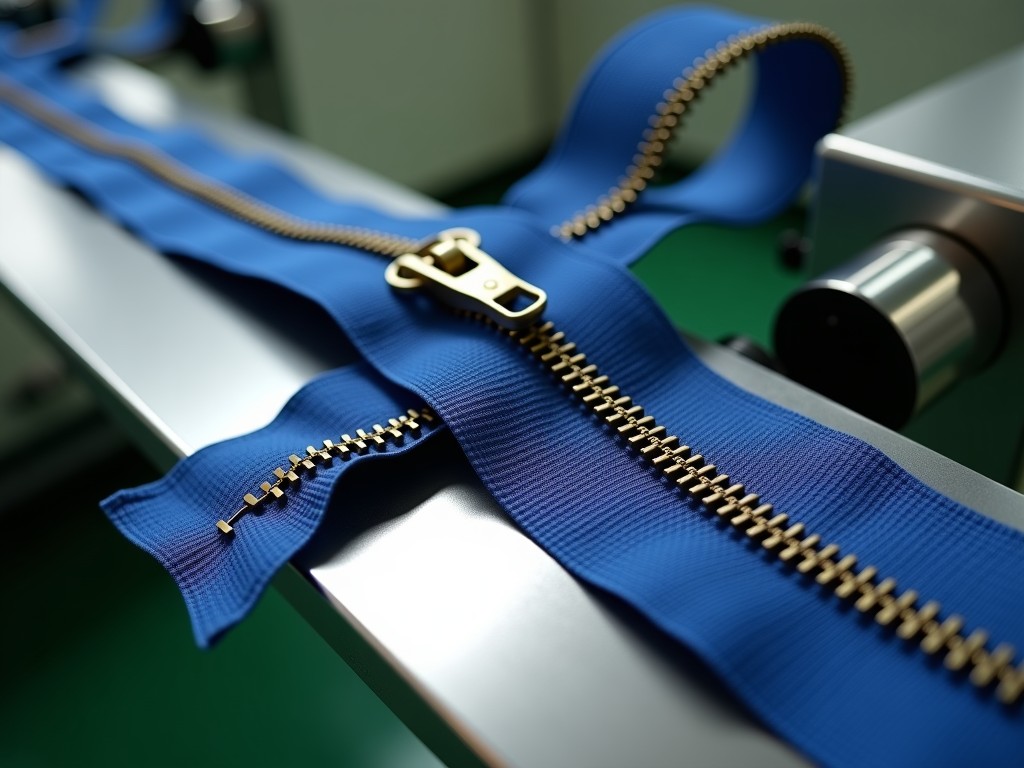
Custom Hidden Zipper Production Machine
Hidden zippers, also called invisible zippers, are sewn into a seam so that only the slender pull tab is visible, providing a clean finish for garments and technical textiles.
Producing them consistently requires precise control of tape feed, needle penetration, and thread tension to avoid visibility of the teeth.
A dedicated production line integrates a tape unwind, zipper forming station, stitching unit, and cutter in a synchronized flow.
Each module is driven by servo motors and monitored by a programmable logic controller to maintain repeatable pitch and tension.
For OEMs that require non-standard widths, tooth geometries, or special tape materials, the machine must be adaptable without lengthy retooling.
Customization of forming dies, needle bars, and tension sensors allows the same platform to serve multiple product families.
Technical Specifications
| Parameter | Typical Value / Customizable |
|---|---|
| Machine model | HZP‑200 series |
| Maximum zipper width | 5 mm – 12 mm (custom dies available) |
| Production speed | Up to 30 m/min (adjustable via servo) |
| Stitch type | Lockstitch 301 (single needle) |
| Needle gauge | Nm 80/12 (optional Nm 90/14 for heavier tapes) |
| Motor power | 2.2 kW servo drive |
| Power supply | 380 V 3‑phase, 50/60 Hz |
| Overall dimensions (L×W×H) | 2100 mm × 800 mm × 1500 mm |
| Machine weight | ≈ 850 kg |
| Control system | PLC with 7‑inch HMI touchscreen |
| Changeover time (die swap) | < 15 min (quick‑release fixtures) |
Key Features
- Servo‑driven tape feed with programmable tension ramp
- Interchangeable forming dies for zipper widths from 5 mm to 12 mm
- Vision‑based alignment sensor that monitors tooth placement within ±0.05 mm
- Automatic cutter with length counter for batch processing
- Energy‑recovery braking reduces peak power draw by ~15 %
Applications
In high‑end fashion, invisible zippers are used on dresses, skirts, and trousers where a visible seam would compromise the silhouette.
The machine’s ability to handle lightweight polyester tapes at high speeds ensures that the zipper remains flat and invisible after sewing.
Automotive seat covers and door panels often require hidden zippers for removable trim.
The reinforced needle bar and optional metal‑tooth dies accommodate the higher abrasion resistance needed in automotive textiles.
Surgical gowns and drapes rely on invisible closures to maintain sterile barriers.
The stainless‑steel tape option and precise tension control prevent micro‑tears that could compromise barrier integrity.
Customization Options
- Tape material: polyester, nylon, polypropylene, or coated stainless steel
- Tooth geometry: standard, reinforced, or low‑profile for lightweight fabrics
- Slider type: lockable, non‑lockable, or automatic
- Feed mechanism: friction roller, air‑assist, or vacuum suction
- Length measurement: incremental encoder or laser sensor for cut‑to‑length
- Integration kits: upstream tape splicer, downstream heat‑seal station
Quality Control Philosophy
Every production run begins with a tape tension validation loop that logs real‑time force feedback to the PLC.
If tension deviates beyond ±0.2 N, the system alerts the operator and automatically reduces feed speed to avoid tooth deformation.
The line‑scan camera positioned after the stitching unit inspects each zipper for tooth visibility and stitch uniformity at a resolution of 0.01 mm.
Defects trigger a reject gate that diverts the offending piece to a quarantine bin without stopping the line.
Statistical process control charts are generated per shift, tracking metrics such as stitch length variance, tape width consistency, and cutter timing jitter.
These data feed into a continuous improvement loop where die wear and needle replacement intervals are optimized based on actual wear rates.
Frequently Asked Questions
- Can the machine be integrated into an existing production line?
- Yes, the modular design allows connection to upstream tape splicers and downstream sealing stations via standard mechanical interfaces.
- What information is required before a quotation is issued?
- Please provide zipper width, tape material, target production speed, and any special features such as slider type or length measurement.
- Which tape materials are compatible with the forming dies?
- Standard dies work with polyester and nylon tapes; optional hardened dies accommodate polypropylene and stainless‑steel tapes.
- How is zipper quality inspected during operation?
- A line‑scan camera checks tooth alignment and stitch uniformity, while tension sensors monitor feed force in real time.
- When can a custom‑built unit be expected?
- Lead time typically ranges from 8 to 12 weeks after design approval, depending on tooling complexity.
Get a Technical Quote
To receive a detailed quotation tailored to your specific zipper width, tape material, and production volume, please share your part drawing or technical requirements.
Request Quote