Custom Invisible Zipper Production Line Factory
Overview
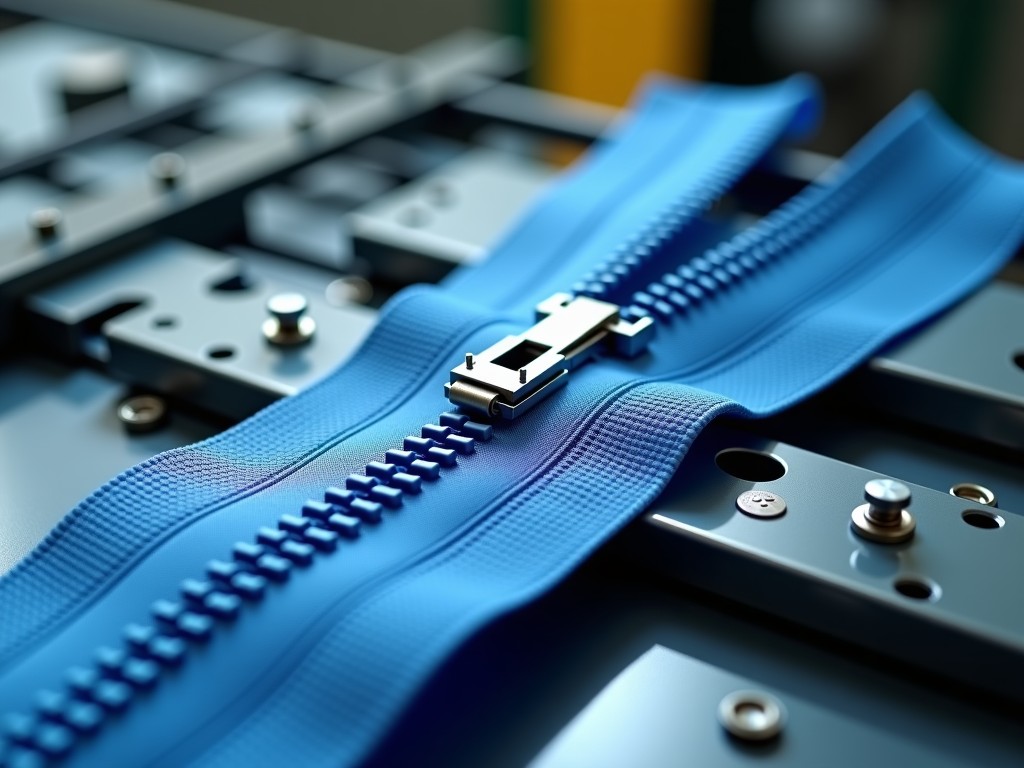
An invisible zipper, also known as a concealed zipper, features teeth that are hidden behind the tape when closed, providing a clean seam appearance. Manufacturing this product requires precise alignment of the tape, teeth, and slider to maintain low profile and consistent operation. A dedicated production line integrates material handling, forming, and inspection stations to achieve the tight tolerances needed for garment and technical textile applications.
The line is engineered for continuous operation with minimal changeover time, supporting both short‑run custom orders and high‑volume standard profiles. Each subsystem is synchronized to keep the zipper tape flat, teeth uniformly spaced, and slider movement within specified friction limits.
Key Technical Specifications
- Maximum line speed: 45 m/min (adjustable via servo drive)
- Tape width range: 3 mm to 12 mm (customizable in 0.5 mm increments)
- Tooth pitch tolerance: ±0.02 mm measured over 100 mm length
- Slider pull force: 0.8 N to 1.5 N depending on coating
- Temperature resistance of tape: –30 °C to +120 °C (standard polyester)
Production Process Flow
The process begins with polyester or nylon tape unwinding from precision tension‑controlled spools. The tape passes through a pre‑heater to reduce moisture content, then enters the tooth‑forming module where interlocking elements are injection‑molded directly onto the tape edges at a controlled temperature profile.
After forming, the zipper tape moves to a cooling station where dimensional stability is verified by laser gauges. The slider is then attached in a separate insertion station that applies a calibrated torque to ensure consistent pull force. Finally, the completed zipper undergoes inline visual and dimensional inspection before being cut to length and wound onto take‑up reels.
Customization Options
- Tape material: polyester, nylon, recycled PET, or flame‑retardant blends
- Tooth geometry: standard, low‑profile, or reinforced for heavy‑duty use
- Slider type: lock‑pull, reversible, or coated with PTFE for reduced friction
- Tape width and length: specified per order, with tolerances as tight as ±0.1 mm
- Surface finishes: matte, glossy, or antimicrobial coating
Quality Control Philosophy
Inspection points are positioned after each major operation to detect deviations early. Laser micrometers monitor tape width and tooth pitch in real time, triggering automatic adjustments if measurements fall outside the defined control limits. Slider attachment torque is logged for every unit to ensure traceability.
Final audit includes a tensile test on a sample of teeth to verify pull‑off strength, a slide‑smoothness test measuring friction coefficient, and a visual check for tape discoloration or tooth deformation. All data are stored in a manufacturing execution system for batch traceability and continuous improvement.
Applications and Suitability
Invisible zippers are favored in high‑end apparel where a seamless appearance is critical, such as formal dresses, tailored trousers, and luxury outerwear. The low‑profile design prevents snagging on fabrics and reduces the need for additional covering flaps, simplifying garment construction.
Technical textiles also benefit from the concealed geometry; for example, automotive seat covers and interior panels use invisible zippers to maintain a smooth surface while allowing removable panels for maintenance. The tape’s resistance to UV and temperature extremes ensures durability in these environments.
Because the production line can adjust tooth geometry and slider friction, it serves both lightweight fashion fabrics and heavier industrial webbing without requiring separate equipment sets.
Configuration Comparison
| Parameter | Standard Setup | Customizable per Project |
|---|---|---|
| Tape Width Range | 3 mm – 8 mm | Up to 12 mm (0.5 mm steps) |
| Tooth Material | Polyacetal (POM) | POM, nylon, or metal‑filled composites |
| Slider Coating | Nickel‑plated | PTFE, DLC, or uncoated |
| Line Speed | 30 m/min (fixed) | 15‑45 m/min (servo‑adjustable) |
| Control System | PLC with basic HMI | SCADA compatible, remote diagnostics |
Frequently Asked Questions
Can the line produce both standard and custom zipper widths in the same run?
Yes. The tape unwinding stations support quick‑change spools, allowing width changes within a few minutes without stopping the line. This enables mixed‑batch production for customers needing multiple widths.
What information is required before a quotation is prepared?
Required details include desired tape width, material type, tooth geometry, slider specifications, target annual volume, and any special certifications (e.g., OEKO‑TEK, REACH). Providing a sample or drawing helps validate tolerances.
How is quality inspected for invisible zippers?
Inline laser gauges monitor tape width and tooth pitch, while a pull‑test station measures slider detachment force. Final audit includes visual inspection under magnification and a slide‑smoothness friction check.
What packaging options are available for finished zippers?
Standard packaging is wound onto anti‑static reels with protective polyethylene film. Alternatives include flat‑packed lengths in corrugated boxes or custom‑length cut pieces sealed in moisture‑barrier bags, all labeled with batch codes.
Get in Touch
To discuss your specific zipper production requirements, share your technical specifications or schedule a consultation with our engineering team. We will provide a detailed feasibility study, including layout considerations, estimated lead time, and cost breakdown.
Contact Us