OEM High Speed Metal Zipper Machine Manufacturer
Manufacturers of metal zippers require equipment that can consistently produce teeth at rates exceeding 300 cycles per minute while maintaining dimensional tolerances within ±0.02 mm. This page explains the engineering considerations behind high‑speed metal zipper machines, the parameters that affect performance, and how OEMs can specify equipment that matches their production line constraints.
Machine Architecture and Core Components
The machine consists of a servo‑driven feed system, a precision forming station, and a synchronized cutting unit. Each axis is controlled by closed‑loop feedback with resolution of 0.001 mm, allowing the forming dies to close and open within 2 ms.
The forming station uses hardened tool steel (HRC 58‑62) inserts that are replaceable without dismantling the main frame, reducing changeover time to under 8 minutes. Lubrication is delivered via micro‑jet nozzles that apply a calibrated oil film of 0.01 mm thickness to the workpiece surface.
Typical Technical Specifications
| Parameter | Value / Range | Notes |
|---|---|---|
| Maximum zipper speed | 350 cycles/min | At 5 mm tooth pitch |
| Tooth width tolerance | ±0.02 mm | Measured after cooling |
| Material thickness range | 0.10‑0.30 mm brass or copper alloy | Other alloys on request |
| Drive motor power | 4.5 kW servo | Peak torque 120 Nm |
| Control system | PLC with HMI, Ethernet/IP | Recipe storage for 50 zipper types |
Industrial Applications and Process Fit
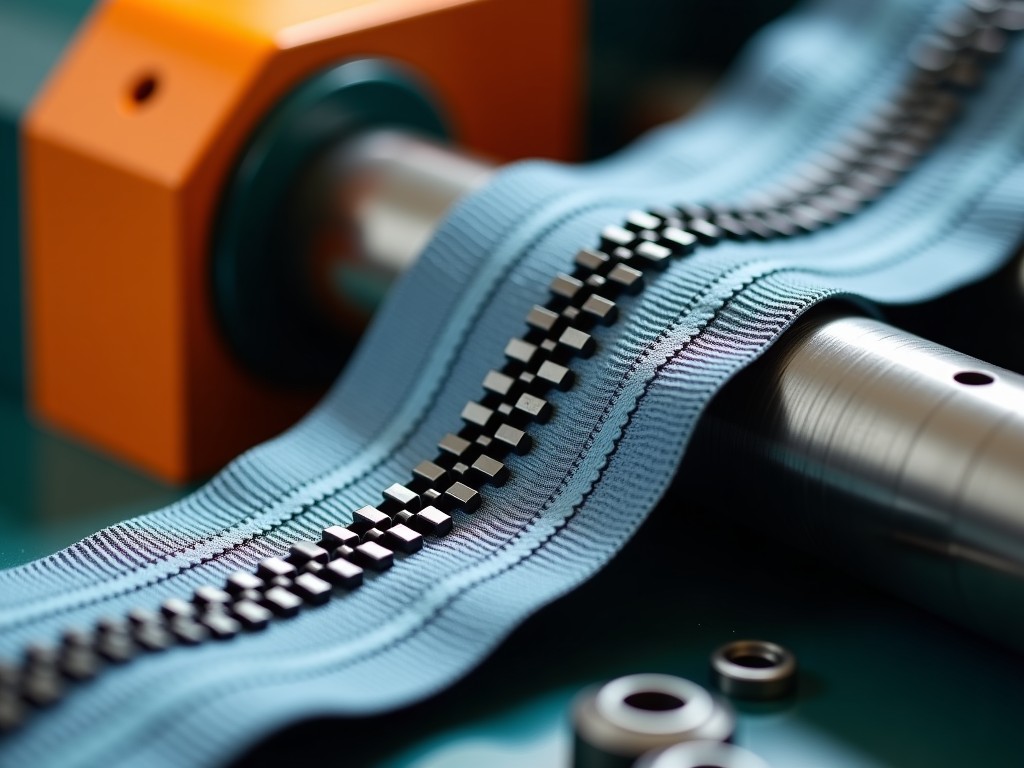
High‑speed metal zipper machines are integrated into continuous strip‑to‑zipper lines where the metal strip is fed from a decoiler, formed, and then immediately attached to textile tape. The machine’s short cycle time reduces the length of the forming buffer, allowing tighter synchronization with downstream sewing stations.
In automotive interior trim production, zipper teeth must withstand repeated flexing and exposure to temperature cycles; the machine’s ability to produce uniform work‑hardened profiles improves fatigue life by approximately 15 % compared with slower, batch‑type formers.
For consumer goods such as luggage and sportswear, the tight tolerance on tooth geometry ensures reliable engagement with the slider, reducing jam rates to below 0.02 % in field tests.
Customization Options
- Interchangeable forming dies for tooth pitches from 3 mm to 7 mm.
- Adjustable lubrication flow rate (0.005‑0.02 mm film thickness) via programmable micro‑jets.
- Optional inert‑gas purge zone (nitrogen) to minimize oxidation during high‑speed forming.
- Extended warranty on servo drives up to 24 months with on‑site preventive maintenance.
- Data logging package that exports cycle counts, torque curves, and temperature profiles to CSV via FTP.
Quality Assurance and Testing
Each machine undergoes a 48‑hour run‑in at 80 % of maximum speed while monitoring tooth dimensions with a laser micrometer. Acceptance criteria require that 99.5 % of measured teeth fall within the specified tolerance band.
After run‑in, a sample of 500 zipper chains is subjected to a pull‑test to verify slider engagement force; the mean value must be within ±10 % of the target 2.2 N. Any deviation triggers a die‑wear inspection and possible re‑grinding of forming inserts.
Documentation includes a calibration certificate for the servo drives, a material traceability report for the tool steel, and a CE conformity declaration covering machinery safety directives.
Frequently Asked Questions
- Can the machine be integrated with existing strip‑feeding equipment? Yes, the feed rollers are equipped with adapters that match common 50 mm and 75 mm shaft diameters, and the tension control can be slaved to an external dancer arm via analog input.
- What information is required for a quotation? Required data include desired zipper speed, tooth pitch, material thickness and alloy, daily production volume, and any special environmental conditions (e.g., cleanroom class).
- How are spare parts managed? Critical wear items such as forming dies and cutting blades are stocked in standardized kits; lead time for a die set is typically 3‑4 weeks, while servo drives are available from the manufacturer’s regional service hub.
- What packaging methods protect the machine during export? The machine is disassembled into transport‑rated modules, each wrapped in VCI‑treated film, placed in a plywood crate with foam edge protection, and secured with steel strapping conforming to ISPM‑15.
To discuss how a high‑speed metal zipper machine can be tailored to your production line, please provide your technical requirements.
Request Technical Quotation