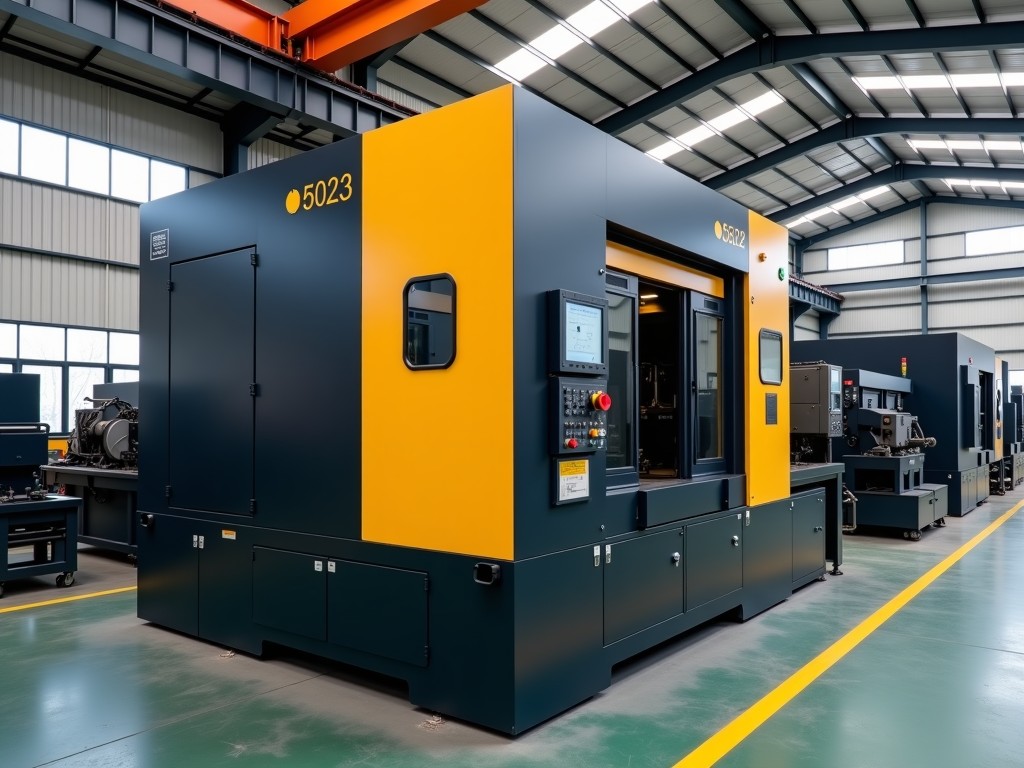
OEM Large Tonnage Metal Die Casting Machine
The machine is engineered for high‑volume production of metal components requiring clamping forces from 1,200 kN to 6,500 kN. Each unit integrates a rigid frame, precision platens, and a programmable hydraulic circuit to maintain repeatable shot‑to‑shot dimensions within ±0.02 mm.
Core Technical Parameters
Key performance figures are presented as typical ranges; exact values are adjusted to match the specific alloy, part geometry, and cycle time required by the OEM.
| Parameter | Typical Range | Adjustment Notes |
|---|---|---|
| Clamping Force | 1,200 kN – 6,500 kN | Selected based on projected part wall thickness and material density |
| Shot Weight | 0.5 kg – 45 kg | Adjusted via plunger diameter and stroke length |
| Platen Size (H×V) | 400 mm × 400 mm – 1,200 mm × 1,200 mm | Customizable to match die footprint and ejection system |
| Injection Pressure | 800 bar – 2,000 bar | Controlled through proportional valve; set per material viscosity |
| Clamp Stroke | 300 mm – 1,200 mm | Determined by part height plus safety clearance |
Structural Design Highlights
The machine frame uses closed‑section steel beams with a moment of inertia exceeding 1.2 × 10⁶ mm⁴, reducing deflection under maximum clamping load to less than 0.1 mm. Platens are hardened to HRC 58‑62 and ground to a flatness of 0.005 mm over the entire surface, ensuring consistent die closure.
Hydraulic power is supplied by a variable‑displacement pump rated at 250 L/min, paired with accumulator banks that absorb pressure spikes during rapid valve actuation. This arrangement limits pressure overshoot to ±5 % of setpoint, protecting both the die and the machine components.
Electrical controls follow IEC 61508 SIL‑2 safety standards, incorporating dual‑channel monitoring of clamp position and injection pressure. Fault detection triggers a safe‑state shutdown within 20 ms, minimizing risk of die damage.
Typical Industrial Applications
Automotive manufacturers employ these machines for engine block, transmission housing, and structural bracket production, where wall thicknesses vary from 3 mm to 12 mm and material grades range from ADC12 to A380 aluminum alloys.
In the aerospace sector, the equipment is used to cast turbine casings and landing‑gear fittings that demand tight tolerances (±0.03 mm) and superior surface finish (Ra ≤ 0.8 µm) to reduce post‑machining.
Heavy‑equipment builders rely on the high shot weight capability to produce large hydraulic pump housings and gearbox casings in magnesium‑alloy variants, achieving weight savings of up to 35 % compared with steel equivalents.
Customization Options
- Platen dimensions adjustable in 50 mm increments to accommodate custom die footprints
- Ejection system selection: mechanical pins, hydraulic pushers, or stripper plates with adjustable force up to 150 kN
- Cooling circuit configuration: number of channels, flow rate control, and optional oil‑to‑water heat exchangers
- Control interface: PLC‑based with optional SCADA integration, touchscreen HMI, and recipe management for up to 200 part programs
- Safety upgrades: light curtains, safety laser scanners, and emergency stop stations meeting ISO 13849‑1 PL e
Each option is evaluated against the part’s projected cycle time, material shrinkage, and required post‑cast machining, ensuring the final machine configuration delivers the lowest total cost of ownership.
Quality Assurance & Testing
Before shipment, every machine undergoes a factory acceptance test (FAT) that includes:
- Clamping force verification at 25 %, 50 %, 75 % and 100 % of rated load using calibrated load cells
- Injection pressure repeatability test over 50 consecutive shots, recording standard deviation
- Platen parallelism measurement with a laser interferometer across the full travel
- Hydraulic leak check at operating temperature (80 °C) for 30 minutes
- Electrical safety inspection per IEC 60204‑1, including grounding resistance and insulation resistance
Test results are documented in a traceable report linked to the machine’s serial number, providing the OEM with verifiable evidence of conformance to the agreed specification.
Frequently Asked Questions
Can the machine dimensions be adapted to fit an existing production line?
Yes. Base frame length, width, and height can be modified in 100 mm steps, and the control cabinet can be repositioned to accommodate limited floor‑space layouts.
What information is required before a quotation is issued?
Part drawing or 3D model, target material alloy, estimated annual volume, required cycle time, and any special features such as inserts or cores.
Which metal alloys are commonly processed?
Aluminum (ADC12, A380, A413), zinc (ZAMAK 3, 5), magnesium (AZ91D, AM60B), and copper‑based alloys (Cu‑Sn, Cu‑Zn) are standard; other alloys are available upon request.
How is quality inspected during production?
In‑process monitoring includes real‑time clamp force and injection pressure logging, optical measurement of critical dimensions after each shot, and periodic X‑ray inspection for internal porosity.
What packaging methods protect the machine during export?
The machine is disassembled into transport‑ready modules, each wrapped in corrosion‑inhibiting film, placed in a custom‑fit wooden crate with shock‑absorbing brackets, and sealed with humidity‑indicating desiccants.
Contact for Technical Inquiry
To discuss how this OEM large tonnage metal die casting machine can be tailored to your specific part requirements, please provide your project details using the form below.
Request a Quote