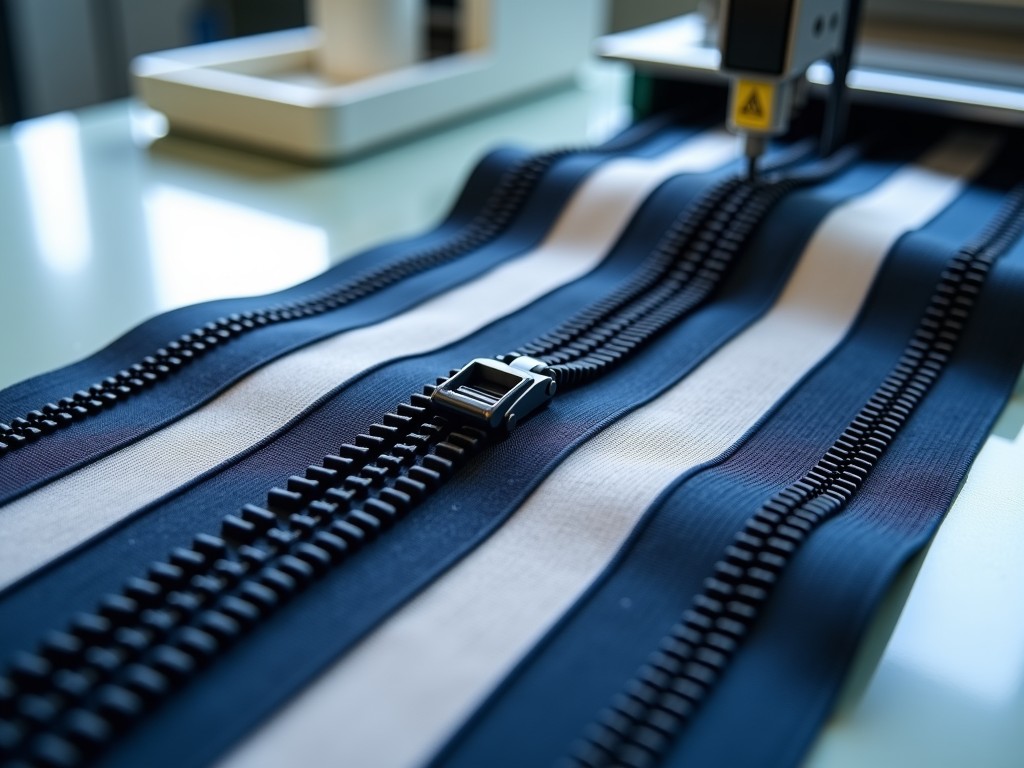
Heavy Duty Nylon Zipper Production Line
A heavy duty nylon zipper production line integrates extrusion, drawing, and tooth forming modules to produce continuous zipper tape with reinforced nylon filaments. The line is engineered for consistent tooth geometry and high tensile strength required in load‑bearing fastening applications.
Technical Overview
The extrusion unit melts PA6 or PA66 resin at controlled temperatures typically between 240 °C and 260 °C, delivering a uniform melt to the spinneret. Melt temperature stability directly influences filament diameter uniformity.
Filaments exiting the spinneret are drawn through a series of heated rollers that increase draw ratio to 3.5–4.5, enhancing molecular orientation and resulting tensile strength. Draw ratio is adjusted via roller speed ratios to meet specific strength targets.
After drawing, the filaments pass through a cooling tunnel where air velocity is maintained at 2–3 m/s to achieve rapid solidification without inducing internal stresses. Cooling efficiency is monitored by infrared sensors to prevent thermal degradation.
Key Engineering Characteristics
The production line’s performance is defined by measurable parameters that directly affect zipper tape quality and downstream processing speed. Typical values are presented below for a standard configuration; actual figures can be adjusted according to project requirements.
| Parameter | Typical Value | Unit | Adjustable Range |
|---|---|---|---|
| Extruder melt temperature | 250 | °C | 230‑270 |
| Draw ratio | 4.0 | – | 3.0‑5.0 |
| Filament denier | 150 | dtex | 100‑200 |
| Tooth pitch | 5 | mm | 4‑6 |
| Tensile strength of tape | 30 | N/mm | 20‑40 |
| Production line speed | 12 | m/min | 8‑20 |
| Tape width | 20 | mm | 10‑30 |
| Power consumption | 15 | kW | depends on output |
Adjusting the draw ratio and filament denier directly modifies the tape’s tensile strength and flexibility, allowing the line to meet varying load requirements. Tooth pitch and width are tailored to match the mating slider design and the intended application’s seam width.
Material Options
The line can process various nylon grades and additives to achieve specific mechanical and environmental properties. Material selection influences abrasion resistance, UV stability, and chemical compatibility.
- PA6 (standard)
- PA66 (higher melting point)
- PA6 with 10 % glass fiber (increased stiffness)
- PA66 with molybdenum disulfide lubricant (reduced friction)
- UV‑stabilized PA6 (enhanced outdoor durability)
- Halogen‑free flame‑retardant PA6 (safety compliance)
Applications
In automotive safety systems, heavy duty nylon zippers are used on seat‑belt pretensioner covers where the fastener must withstand rapid deceleration forces exceeding 20 kN without tooth deformation. The line’s tight control over draw ratio ensures consistent tensile strength above 30 N/mm, meeting the required safety margin.
For industrial bulk containers, the zipper tape provides a resealable closure that maintains integrity under repeated loading cycles of up to 50,000 flexes, a requirement for reusable freight bags. The ability to adjust tooth pitch to 5 mm optimizes seam strength while allowing easy slider movement.
Outdoor equipment manufacturers select the line’s UV‑stabilized nylon to produce zippers that retain >80 % of original tensile strength after 500 hours of simulated sunlight exposure, ensuring long‑term service life in harsh environments. Adding a molybdenum disulfide lubricant reduces friction coefficient to below 0.2, improving slider durability in sandy conditions.
Customization Logic
Customization begins with the selection of screw profile and barrel length in the extruder to match the melt viscosity of the chosen nylon grade. Changing the draw roller configuration alters the draw ratio, which in turn sets the filament’s tensile modulus.
The tooth forming station uses interchangeable molding inserts that can produce tooth profiles ranging from standard coil to hidden or water‑resistant designs. Adjusting the insert spacing changes the pitch, allowing the line to produce tapes from 4 mm to 6 mm pitch without mechanical retooling.
Line speed is regulated by a variable frequency drive on the take‑up winch, enabling production rates from 8 m/min to 20 m/min while maintaining tensile tolerance within ±2 %. Width adjustment is achieved via sliding side guides on the winding unit, accommodating tape widths from 10 mm to 30 mm.
Quality Control Philosophy
Quality assurance starts at the extruder melt pressure sensor, which logs pressure variance to detect material inconsistencies before filament formation. Inline laser diameter monitors measure filament deviation, triggering automatic alarm if tolerance exceeds ±5 µm.
After tooth forming, a vision system inspects each tooth for geometric defects such as flash, underfill, or misalignment at a resolution of 0.02 mm. Samples are periodically cut for tensile testing using a calibrated Instron‑type tester, with results logged against batch numbers.
Final tape undergoes a cyclic flex test where a slider is drawn across the zipper 10,000 times at a speed of 0.5 m/s; any increase in insertion force beyond 15 % of initial value leads to batch rejection. All data are stored in a traceable database linked to the production order.
Frequently Asked Questions
- Can dimensions be customized?
- Yes, tooth pitch, tape width, and line speed are adjustable within the ranges specified in the technical table to suit specific slider and seam requirements.
- What information is required before quotation?
- We need the desired nylon grade, target tensile strength, tooth pitch, tape width, annual volume, and any special additives (e.g., UV stabilizer, lubricant).
- What materials are available?
- Standard PA6, PA66, glass‑filled PA6, lubricated PA66, UV‑stabilized PA6, and halogen‑free flame‑retardant PA6 are available; other grades can be evaluated upon request.
- How is quality inspected?
- Inspection includes melt pressure monitoring, laser diameter control, vision‑based tooth geometry check, periodic tensile testing, and a 10,000‑cycle flex test with force‑change limits.
- What is the typical production lead time?
- Lead time depends on order complexity and current capacity; typically 4‑6 weeks for standard configurations, with expedited options available for critical projects.