Wholesale Nylon Zipper Production Line – B2B Supplier
A nylon zipper production line converts polyamide‑6 or polyamide‑6,6 resin into zipper tape and sliders through a series of extrusion, drawing, twisting, and cutting stations. The line operates continuously, delivering tape widths from 2 mm to 10 mm with tooth pitches ranging from 3 mm to 5 mm, suitable for apparel, luggage, and technical textiles.
Technical Overview
The extrusion module melts nylon resin at 260 °C to 280 °C and forces it through a die to form a flat tape. Temperature uniformity within ±2 °C ensures consistent crystallinity and tensile strength.
After extrusion, the tape passes through a series of drawing rollers that reduce thickness and orient polymer chains, increasing tenacity to typically 45–55 cN/tex. Roller speed ratios are adjustable to meet target denier specifications. A water‑cooling bath follows the draw zone to set the dimensions before twisting.
The twisting unit interlaces the tape with monofilament nylon yarn to create the tooth profile. Twist density is controlled by gear ratio, yielding tooth heights between 0.8 mm and 1.2 mm and flank angles of 20°–25°.
Cutting stations slice the continuous tape to lengths defined by a programmable length counter, with tolerance ±0.5 mm. Slider assembly inserts pre‑formed zinc‑alloy or plastic sliders, engaging the teeth at a force of 0.8–1.2 N per tooth. An inline vision system checks tooth alignment and rejects out‑of‑spec units at a rate below 0.2%.
Key Specifications
The following table lists typical adjustable ranges for a standard nylon zipper production line. Exact values depend on resin grade, desired tape width, and slider type.
| Parameter | Typical Value | Unit | Notes |
|---|---|---|---|
| Extrusion Temperature | 260–280 | °C | Melt zone |
| Drawing Ratio | 3–5 | – | Speed ratio |
| Tape Width | 2–10 | mm | Adjustable die |
| Tooth Pitch | 3–5 | mm | Standard coil |
| Slider Engagement Force | 0.8–1.2 | N/tooth | Measured per ASTM D2061 |
| Production Speed | 30–120 | m/min | Dependent on width |
| Power Consumption | 15–30 | kW | Motor drive |
| Control System | PLC + HMI | – | standard industrial PLC |
Applications
Apparel manufacturers use nylon zippers for garments requiring flexibility and resistance to repeated washing; the tape’s low moisture regain (<4 %) maintains dimensional stability after laundering.
Luggage and bag producers benefit from nylon’s high abrasion resistance (Martindale >30 000 cycles) and UV stability, which prolongs service life in outdoor exposure.
Technical textile sectors such as automotive interiors and sports equipment select nylon zippers for their chemical resistance to oils and fuels, retaining >90 % tensile strength after 100 h immersion in ASTM D471 test fluid.
Customization Options
Customization is achieved by adjusting die geometry, drawing ratios, and slider molds to meet specific performance criteria.
- Tape Width: 2 mm–10 mm
- Tooth Profile: standard, invisible, water‑repellent
- Slider Type: metal, plastic, lock‑pull
- Tape Color: custom color matching
- Coating: silicone, PTFE for low friction
- Length Setting: fixed length or continuous roll
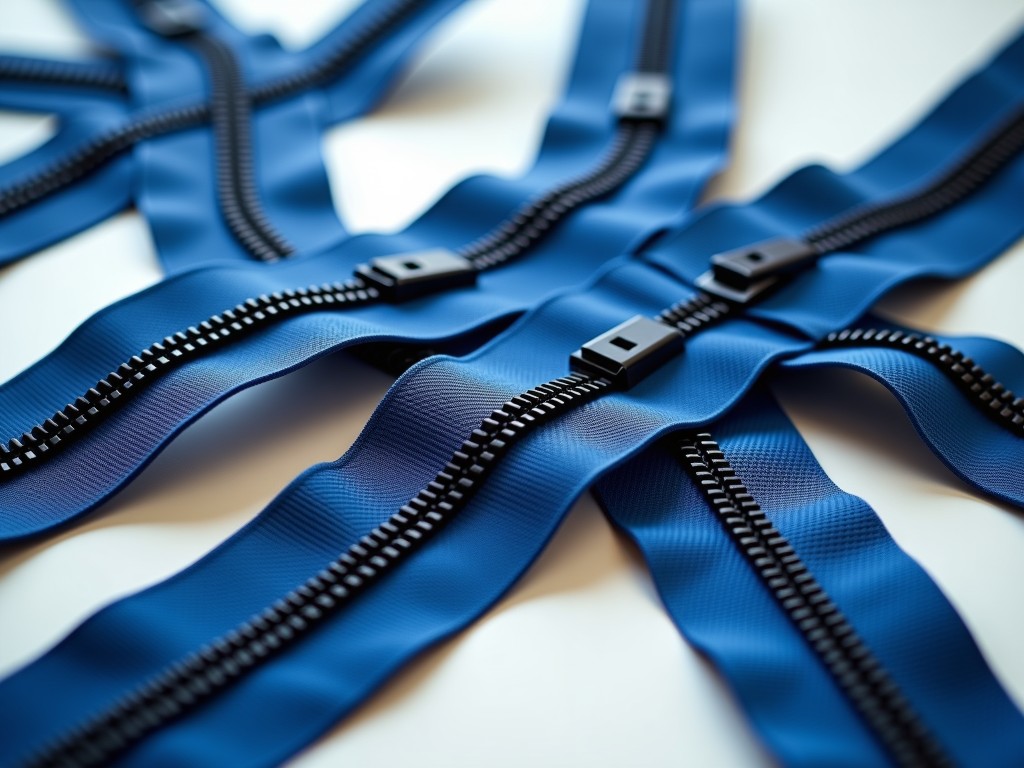
Quality Control
Quality assurance begins with incoming resin testing for melt flow index (MFI 2.0–3.5 g/10 min) and moisture content (<0.02 %).
In‑line monitoring uses laser micrometers to verify tape width (±0.02 mm) and tooth pitch (±0.05 mm) at 10 Hz sampling.
Mechanical testing on finished zipper chains measures tensile strength (≥45 N/5 mm) and slider engagement force (0.8–1.2 N/tooth) per ASTM D2061.
Environmental testing includes colorfastness to washing (ISO 105‑C06 rating ≥4) and UV exposure (ASTM G154, ≤5 % strength loss after 500 h).
Production Process Flow
The production flow begins with resin feeding, proceeds through extrusion, drawing, twisting, cutting, slider insertion, and ends with coiling or bagging. Each stage is interlocked via PLC logic to maintain line speed synchronization within ±1 %.
Frequently Asked Questions
Can dimensions be customized?
Yes, tape width, tooth pitch, and length are adjustable via die and gear changes; typical ranges are listed in the specifications table.
What information is required before quotation?
Required data include desired tape width, tooth profile, slider type, order volume, and any special coating or color specifications.
Which nylon grades are available?
Commonly supplied grades are PA6 and PA6,6 with viscosities ranging from 2.0 to 3.5 dL/g; other grades can be sourced upon request.
How is quality inspected?
Inspection combines laser micrometry, tensile testing, and visual checks; acceptance criteria follow ASTM D2061 and internal control limits.
What is the typical production lead time?
Lead time for a standard configuration is 4–6 weeks after receipt of technical details and deposit; expedited schedules are available for tooling‑ready projects.
Contact Us
To discuss a customized nylon zipper production line, provide your technical requirements and expected volume via the inquiry form.