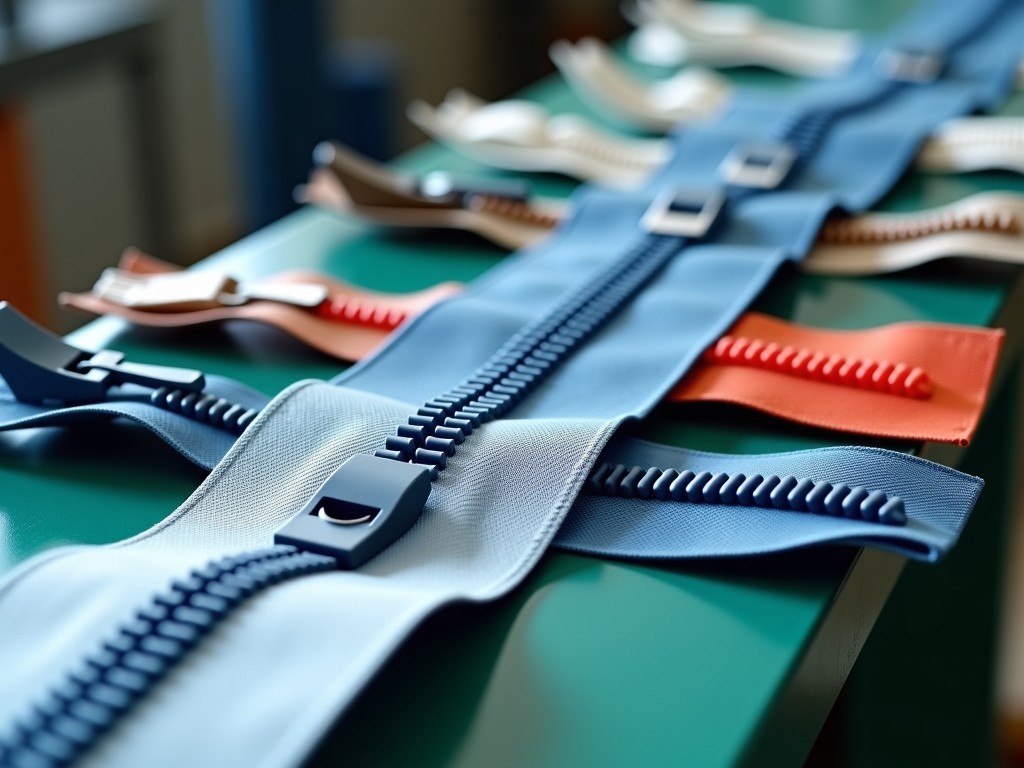
China Plastic Zipper Production Line Manufacturer
A plastic zipper production line integrates extrusion, shaping, cooling, cutting and winding modules to convert polymer granules into finished zipper tapes and teeth. The line handles materials such as polyester, nylon 6,6 and PVC compounds, delivering continuous output that can be directly fed to downstream assembly equipment.
The extruder melts and homogenizes the polymer at controlled temperatures typically ranging from 180 °C to 230 °C depending on material grade. A precision die shapes the molten stream into flat tape or profiled tooth geometry, while a calibrated cooling system solidifies the product without inducing internal stresses.
Downstream units include a pull‑off mechanism that maintains constant tension, a cutting station that cuts tape to programmed lengths, and a winding unit that spools the finished product onto bobbins or carts. Synchronization between modules is achieved via PLC‑driven servo drives, allowing speed adjustments from 5 m/min to 30 m/min without stopping the line.
- Zipper tape width: 3 mm to 25 mm (customizable)
- Tooth profile: standard coil, invisible, metal‑look, water‑repellent
- Tape thickness: 0.08 mm to 0.25 mm
- Production speed: adjustable via servo drive, 5‑30 m/min
- Control system: PLC with HMI, recipe storage for rapid change‑over
| Parameter | Typical Value | Notes |
|---|---|---|
| Extruder Diameter | 45 mm – 90 mm | Selected based on output requirement |
| Maximum Output | Up to 120 kg/h | Depends on material density |
| Zipper Width Range | 3 mm – 25 mm | Tooling change required for extremes |
| Line Speed | 5 m/min – 30 m/min | Servo‑controlled, smooth ramp |
| Power Consumption | 15 kW – 45 kW | Varies with extruder size and speed |
| Control Voltage | 380 V 3‑phase, 50/60 Hz | Optional transformer for other voltages |
The line serves manufacturers of apparel, luggage, sporting goods and automotive trim where consistent tape dimensions and tooth geometry directly affect product durability and appearance. By maintaining tight tolerances on tape width (±0.05 mm) and tooth pitch (±0.1 mm), the equipment reduces scrap and rework in downstream sewing operations.
Quality assurance incorporates inline laser width monitors, tension feedback loops and visual inspection stations that detect surface defects such as gels, burns or misaligned teeth. Data from these sensors feed back to the PLC to adjust die gap or cooling intensity in real time, ensuring stable output over extended runs.
Frequently Asked Questions
- Can the line be adapted for specialty coatings? Yes, secondary extrusion or spray modules can add antimicrobial, UV‑stable or water‑repellent layers.
- What information is needed for a quotation? Required inputs include target zipper width, material type, desired output rate and any post‑processing steps.
- How are spare parts managed? Critical wear items such as dies, cutting blades and cooling rollers are stocked with standard lead times of 2‑4 weeks.
- What is the typical installation timeline? Mechanical erection takes 2‑3 weeks, followed by electrical commissioning and performance testing over an additional week.
To discuss specific configuration options, request a detailed technical datasheet or arrange a virtual factory review, please use the contact link below.
Request Technical Specification