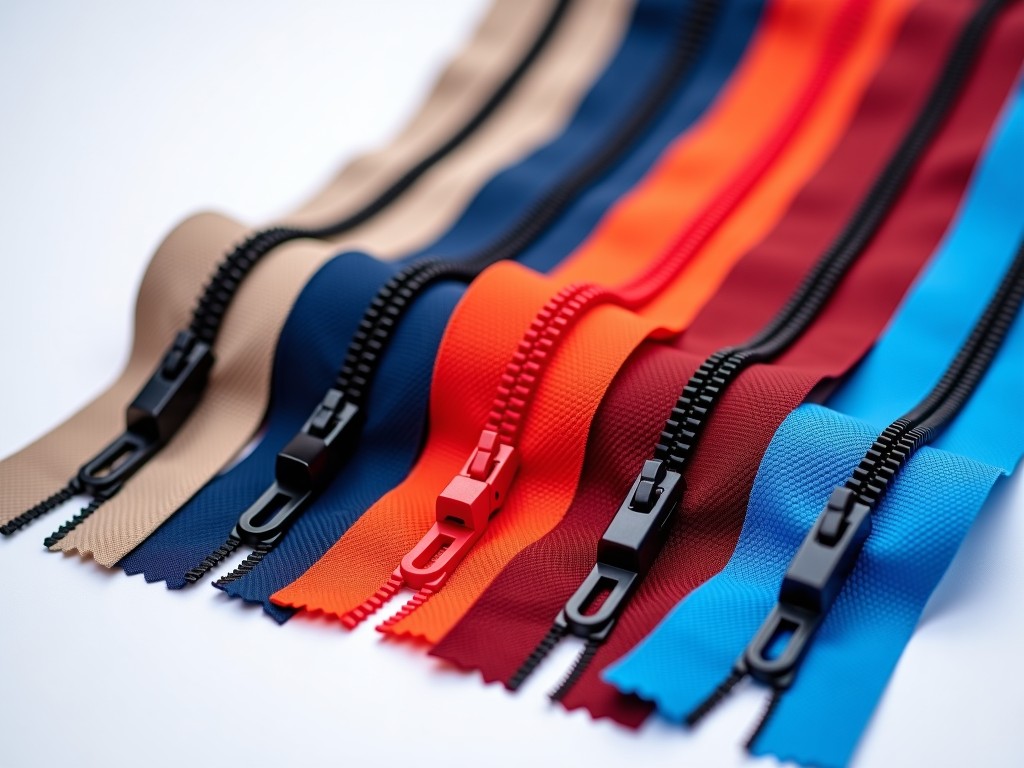
Custom Colored Zipper Tape: Supplier Capabilities
Zipper tape forms the continuous foundation for zipper chains, providing the substrate onto which teeth are formed and the fabric that guides slider movement. In demanding environments, the tape must maintain dimensional stability, resist UV fading, and endure repeated flexing without delamination.
Material Composition
The base tape is typically woven from high-tenacity polyester or nylon filament yarns, selected for their tensile strength and low moisture absorption. Color is imparted through a high‑temperature dyeing process that penetrates the filament core, ensuring hue consistency across the tape width and length.
- Polyester filament – excellent UV resistance, suitable for outdoor applications.
- Nylon filament – higher elongation, preferred where flexibility is critical.
- Blended constructions – balanced properties for specific performance targets.
Customization Process
Custom color matching begins with a spectrophotometer reading of the customer’s reference sample. The lab formulates a dye recipe that meets the target L*a*b* values while accounting for the substrate’s base shade. Width, thickness, and finish are adjusted during weaving and subsequent heat‑setting to meet the exact specifications.
- Pantone, RAL, or custom color references.
- Tape widths from 3 mm to 38 mm in 0.5 mm increments.
- Thickness options ranging from 0.18 mm to 0.45 mm.
- Surface finishes: matte, semi‑gloss, or water‑repellent coating.
- Optional additives: antimicrobial treatment or flame‑retardant finish.
Manufacturing Considerations
After yarn preparation, the tape is woven on narrow‑width looms equipped with tension‑control systems to maintain consistent pick density. The woven tape then passes through a continuous dye‑fixation line where temperature, time, and pH are tightly regulated. Finally, a heat‑setting oven stabilizes the dimensions and locks in the color.
Quality Control & Testing
Each production lot undergoes a series of objective tests to verify that the tape meets the agreed‑upon performance criteria. Results are recorded against statistical process control limits to detect drift early.
| Property | Test Method | Typical Requirement |
|---|---|---|
| Colorfastness to light (ISO 105‑B02) | Xenon arc, 150 h | ≥ 4 (blue wool scale) |
| Tensile strength (ASTM D5034) | Grab test, 25 mm × 200 mm | ≥ 15 N/mm (polyester) |
| Abrasion resistance (Martindale) | 9 kPa pressure | ≥ 20 000 cycles |
| Dimensional stability (heat‑set) | 150 °C, 5 min | ≤ 0.5 % shrinkage |
Applications
Because the tape’s color is locked into the polymer matrix, it retains hue stability under prolonged UV exposure, making it suitable for products where appearance must survive outdoor service. The tape’s tensile strength and low elongation also support reliable slider function in high‑cycle applications.
- Automotive interior trim – color‑matched to interior panels, resistant to sunlight and temperature cycling.
- Outdoor recreation gear – tents, backpacks, and marine equipment where UV stability and abrasion resistance are critical.
- Medical device pouches – requires biocompatible polyester and repeatable sterilization cycles.
- Industrial protective clothing – where flame‑retardant finishes and high‑visibility colors are specified.
Ordering Information
Minimum order quantities are determined by the width and color complexity; typical starting points are 500 m for standard shades and 2000 m for custom matches. Pre‑production samples are produced on lab‑scale looms for approval before full‑scale runs. Lead times range from 3 weeks for stock colors to 6‑8 weeks for newly developed hues, depending on dye‑lot size.
To discuss your specific color, width, or finish requirements, please use the contact link below.