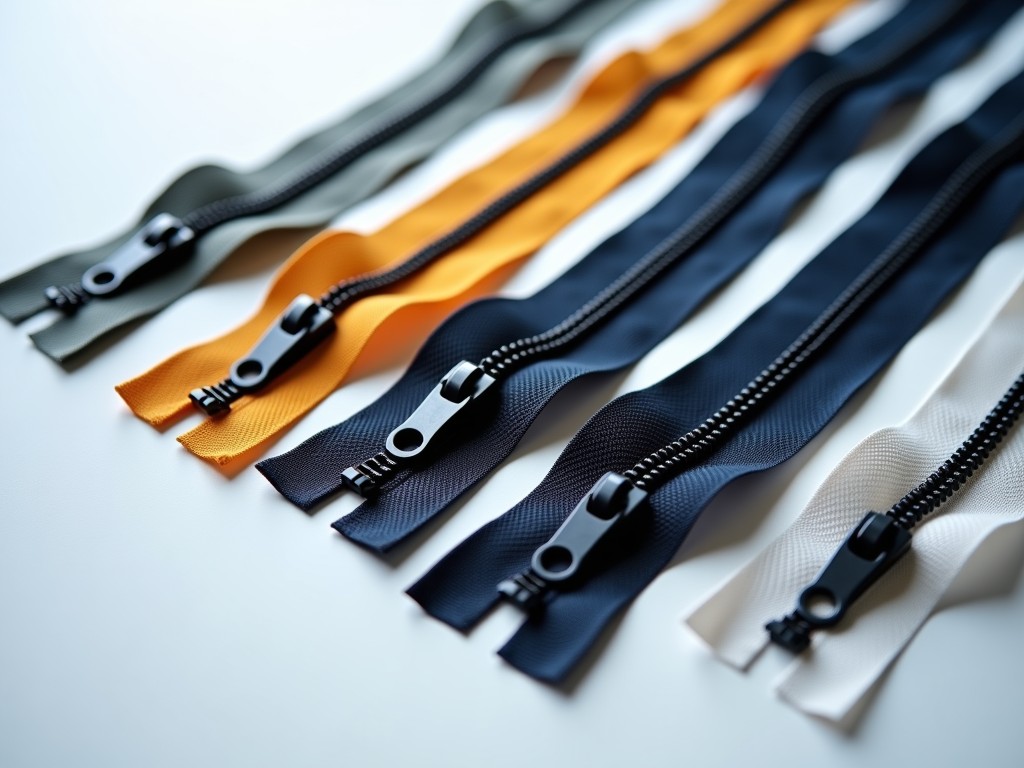
Custom Zipper Fastening Hardware Accessories
The product line comprises sliders, pulls, stops, and reinforcement tapes engineered for repeated opening‑closing cycles in demanding environments.
Material Selection and Performance
Choosing the right alloy or polymer determines corrosion resistance, tensile strength, and temperature tolerance.
- Stainless steel 304 offers >500 MPa ultimate tensile strength and resists salt‑spray exposure for >500 hours.
- Brass C36000 provides good wear resistance with a typical hardness of 80 HRB and is suitable for decorative finishes.
- Engineered polyacetal (POM) delivers low friction coefficient (<0.2) and operates continuously from –40 °C to +80 °C.
- Aluminum 6061‑T6 provides a strength‑to‑weight ratio of ~150 kN·m/kg and accepts anodizing for color coding.
Design Flexibility and Customization
Every geometry can be adjusted to match specific textile thicknesses, load requirements, or aesthetic constraints.
- Slider width adjustable from 3 mm to 12 mm in 0.5 mm increments.
- Pull tab length customizable between 8 mm and 25 mm with optional ergonomic contours.
- Stop designs include single‑pin, double‑pin, and magnetic variants, each rated for specific retention forces.
- Reinforcement tape thickness selectable from 0.05 mm to 0.20 mm, with adhesive backing options.
Tolerances are held to ±0.02 mm for critical dimensions, ensuring consistent engagement force across production batches.
Manufacturing Considerations
Cold forming, stamping, and injection molding are selected based on material and volume.
Tooling life exceeds 500 000 cycles for stainless steel dies, reducing per‑part cost at high volumes.
Secondary operations such as deburring, passivation, or laser etching are performed in‑line to maintain lead times.
Quality Assurance
Each lot undergoes dimensional inspection, pull‑test verification, and corrosion‑resistance screening.
- Critical dimensions measured with optical comparators; acceptance criterion ±0.02 mm.
- Pull‑test applies a static load of 150 N for 10 seconds; no deformation allowed.
- Salt‑spray test per ASTM B117 for 48 hours; visual inspection for rust or pitting.
- Cycle life validation: 10 000 open‑close cycles at 2 N·m torque, evaluating wear on teeth and slider.
Typical Applications
The accessories serve industries where reliable closure and repeated actuation are essential.
- Outdoor performance gear: jackets, tents, and backpacks requiring resistance to UV, moisture, and abrasion.
- Medical protective garments: sterile gowns and covers where smooth operation prevents contamination risks.
- Industrial workwear: coveralls and tool belts that must retain closure under mechanical stress.
- Transportation interiors: seat covers and cargo nets where vibration resistance is critical.
Technical Data Overview
| Parameter | Typical Value / Range | Notes |
|---|---|---|
| Slider width | 3 mm – 12 mm | Customizable in 0.5 mm steps |
| Tensile strength (steel) | ≥500 MPa | ASTM A240 |
| Operating temperature (POM) | –40 °C to +80 °C | Continuous use |
| Pull‑test load | 150 N (static) | No deformation acceptance |
| Cycle life | ≥10 000 cycles | At 2 N·m torque |
| Salt‑spray resistance (304 SS) | >500 hours | ASTM B117 |
Frequently Asked Questions
Can dimensions be customized?
Yes. Slider width, pull length, and stop geometry are adjustable per drawing or sample, with tolerances typically held to ±0.02 mm.
What information is required before quotation?
Provide material preference, required dimensions, expected load, environmental exposure (e.g., salt spray, UV), and annual volume.
What materials are available?
Stainless steel 304, brass C36000, aluminum 6061‑T6, and engineering polyacetal (POM) are standard; other alloys or coatings are available upon request.
How is quality inspected?
Each batch undergoes dimensional checks, pull‑test validation, salt‑spray exposure, and cycle‑life testing as outlined in the quality section.
What packaging methods are available?
Parts are packed in anti‑static trays, sealed polybags, or corrugated cartons with desiccant; custom labeling and palletization are offered.
How are export shipments protected?
Shipments include moisture‑barrier bags, corner protectors, and comply with ISPM‑15 wood‑packing standards when applicable.
What is the typical production lead time?
Lead time ranges from 3 weeks for stocked materials to 6‑8 weeks for tool‑intensive custom parts, depending on order complexity.
How are samples arranged?
Sample kits can be dispatched within 5 business days after approval of drawings; shipping costs are borne by the requester.
Request a Quote
To discuss your specific zipper fastening hardware needs, provide application details and required quantities.
Contact Us