Wholesale Metal Zipper Accessories and Parts Manufacturer
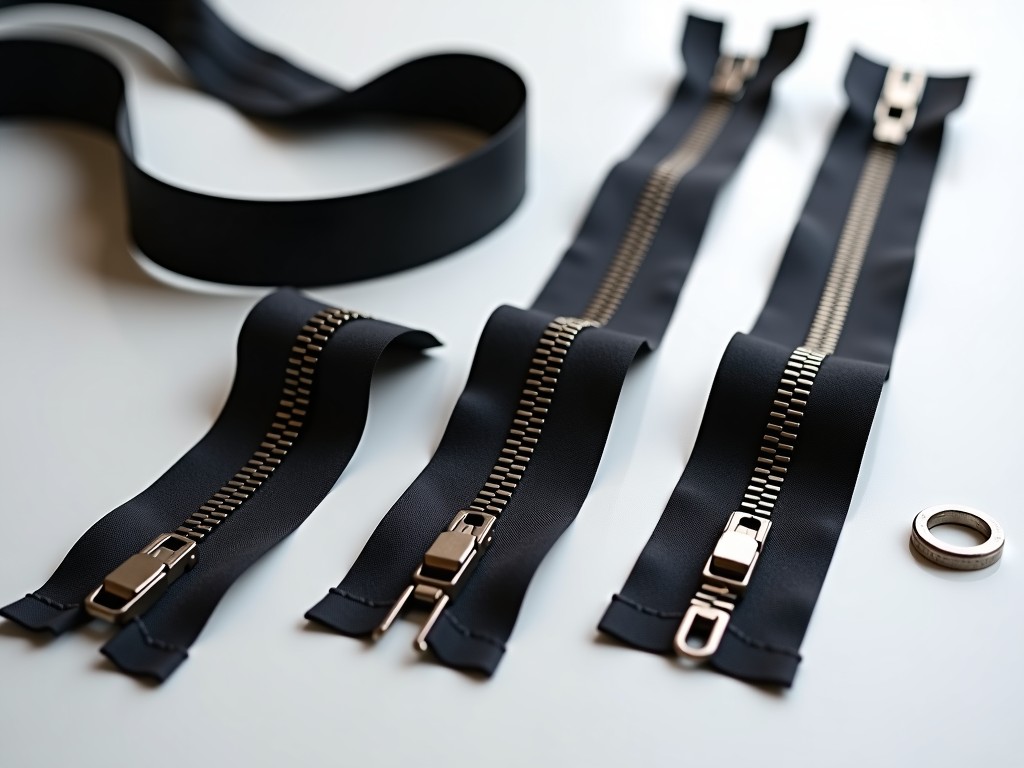
The core offering consists of precision‑engineered metal components that form the functional elements of zippers: sliders, top and bottom stops, teeth (chain), pulls, and reinforcement tapes. Each part is produced to tight dimensional tolerances to ensure smooth operation and long‑term durability in demanding environments.
Product Range
Accessories are organized by function and geometry. Sliders are available in automatic, semi‑automatic, and lock‑type configurations, with varying flange widths to match different tape thicknesses. Stops include barrel, pin, and box designs, each engineered to resist pull‑out forces exceeding 30 N. Tooth profiles range from conventional coil‑to‑injection molded metal teeth, offered in pitches from 3 mm to 8 mm. Pulls and tabs can be stamped, die‑cast, or machined, providing options for branding integration.
Materials and Finishes
Base materials are selected according to required strength, corrosion resistance, and weight. Common choices include brass (CuZn37), stainless steel (AISI 304), and zinc alloy (Zamak 3). Finishes range from raw brass, nickel plating, black oxide, to environmentally friendly trivalent chromium coatings. Each finish is specified by thickness (typically 5–15 µm) and salt‑spray resistance rating (up to 200 h for nickel, 500 h for chrome).
| Material | Typical Tensile Strength (MPa) | Corrosion Resistance (Salt Spray, h) | Common Finish |
|---|---|---|---|
| Brass (CuZn37) | 350–450 | 80–120 (nickel) | Nickel, antique brass |
| Stainless Steel (AISI 304) | 520–720 | >1000 (passive) | Passivated, black oxide |
| Zinc Alloy (Zamak 3) | 260–320 | 150–250 (trivalent Cr) | Trivalent chromium, paint |
Manufacturing Process
Production starts with coil feeding into high‑speed progressive dies that blank, form, and pierce the basic shapes in a single stroke. Secondary operations such as CNC milling or turning are applied to slider bodies that require complex internal geometries. After forming, parts undergo deburring, ultrasonic cleaning, and then surface treatment—either electroplating in a rack‑line system or dip‑coating for uniform film. Final inspection includes optical measurement of critical dimensions and functional testing of slider travel.
Customization Capabilities
Engineers can tailor virtually every parameter to match OEM specifications. Adjustable elements include tooth pitch and profile, slider cam geometry, stop retention force, and overall length of tape‑mounted accessories. Surface treatments can be altered for specific environmental exposure, and branding options range from laser‑etched logos to over‑molded thermoplastic inserts.
- Tooth pitch: 3 mm, 4 mm, 5 mm, 6 mm, 8 mm
- Slider type: automatic, semi‑automatic, lock, reversible
- Finish thickness: 5–20 µm, selectable per coating
- Logo application: laser etch, pad print, over‑mold
- Packaging: bulk trays, reels, or custom blister packs
Quality Control
Quality assurance follows a multi‑stage plan. Incoming raw material is verified with mill certificates and spectrometer checks for alloy composition. In‑process gauges monitor die wear and part dimensions every 15 minutes. Finished batches receive AQL‑based visual inspection (level II) and functional tests: slider pull‑force (target 1.2–1.8 N), stop retention (>30 N), and corrosion exposure per ASTM B117. All data are logged in a traceable ERP system linked to each production lot.
Applications
Metal zipper accessories are chosen when mechanical reliability outweighs weight considerations. In heavy‑duty luggage and outdoor gear, stainless‑steel teeth and nickel‑plated stops resist abrasion and salt‑air corrosion. Automotive interior trim utilizes brass sliders with black oxide finish to match interior aesthetics while providing low‑friction operation. Industrial protective covers often employ zamak pulls with trivalent chromium coating to meet RoHS compliance and withstand frequent cleaning cycles.
| Parameter | Typical Tolerance | Test Method |
|---|---|---|
| Tooth pitch | ±0.05 mm | Caliper / optical comparator |
| Slider width | ±0.10 mm | Micrometer |
| Stop retention force | ≥30 N | Tensile tester |
| Coating thickness | 5–20 µm (±2 µm) | X‑ray fluorescence |
Frequently Asked Questions
- Q: Can dimensions be customized beyond standard catalog sizes? A: Yes. Tooth pitch, slider geometry, and stop dimensions are adjustable per drawing; tooling lead time depends on complexity.
- Q: What information is required before quotation? A: Required data include material preference, finish type, required tolerances, annual volume, and any special branding or packaging instructions.
- Q: Which materials are available for corrosive environments? A: Stainless steel (AISI 304/316) and zinc‑alloy with trivalent chromium coating are standard options; higher grades can be sourced upon request.
- Q: How is quality inspected for batches? A: Each lot undergoes dimensional sampling (AQL II), functional pull‑force testing, and salt‑spray exposure according to ASTM B117, with results retained for traceability.
- Q: What packaging methods are available for overseas shipment? A: Parts can be packed in anti‑static trays, sealed poly‑bags with desiccant, or custom‑molded blister packs, all conforming to ISPM‑15 wood‑free standards for export.
- Q: What is the typical production lead time? A: For standard tooling, lead time is 3–4 weeks after drawing approval; custom tooling adds 2–3 weeks.
- Q: How are samples arranged? A: Sample kits (up to five variations) are shipped via express coupons within 5 working days after approval of the sample request form.
Request a Quote
To discuss your specific zipper accessory requirements, please provide drawings, material preferences, and expected annual usage. Our engineering team will review the submission and return a detailed quotation within two business days.